
Home » The Wrong Fabric Choice Can Make Your Balcony Too Dark, Too Hot, or Completely Unusable: A Guide to Zipscreen™ Customisation in Singapore
Zipscreen™ Fabric & Customisation: Don’t Ruin Your Balcony Renovation
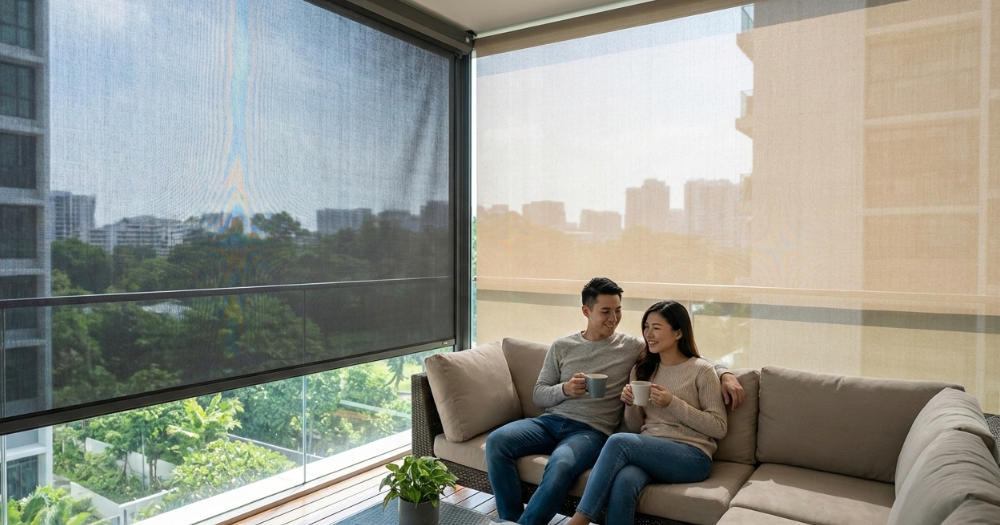
Why Openness Factors, Material Composition, and Colour Choices Matter More Than the Motor Brand
Most Singaporean homeowners spend weeks choosing a sofa but only minutes picking their balcony blind fabric. This is a critical mistake. Choosing the wrong specification can turn your expensive balcony into a heat trap or a dark cave. This guide breaks down the science of openness factors (1% vs. 5%), the truth about rain protection, and how to navigate MCST rules without compromising your view. We dive into data-driven comparisons and real-world case studies to help you customize the perfect Zipscreen™ for your home.
Zipscreen™ Fabric & Customisation: Don’t Ruin Your Balcony Renovation
The Physics of Comfort: Why Fabric Choice is the "Engine" of Your Blinds
Imagine buying a Ferrari but fitting it with bicycle tires. That is exactly what happens when you invest in a premium Zipscreen™ system but select the wrong fabric. In Singapore’s tropical climate, where the monsoon season battles the blistering equator sun, your fabric choice dictates 90% of the blind’s performance.
The wrong choice doesn’t just look bad—it makes your balcony too dark to enjoy during the day, too hot because of heat absorption, or completely unusable due to lack of airflow. This cornerstone guide will walk you through the technical specifications, openness factors, and customization options to ensure your balcony becomes an extension of your living room, not a storage space.
Understanding Openness Factors: 1% vs. 3% vs. 5%

The “Openness Factor” (OF) refers to the weave density of the fabric. It represents the percentage of open space in the fabric mesh.
The 1% Openness Factor (The Privacy Shield)
- Best for: West-facing balconies (afternoon sun) or low-floor units facing neighbors/pool.
- Pros: Blocks up to 99% of UV rays and rain. Provides maximum privacy.
- Cons: Significantly restricts airflow. Can make the balcony feel “stuffy” if fully closed.
- Data Benchmark: Reduces ambient temperature by roughly 4-6°C in direct sunlight but reduces lux (light) levels by over 80%.
The 3% Openness Factor (The Balanced Choice)
- Best for: Most Singapore condos (North/South facing).
- Pros: Great balance between rain protection and ventilation.
- Cons: Moderate visibility at night when lights are on inside.
The 5% Openness Factor (The View Maximizer)
- Best for: East-facing balconies or high-floor units with unblocked views.
- Pros: Excellent airflow and maintains the view even when blinds are down.
- Cons: Let’s in more rain during heavy storms (mist effect) and offers less privacy.
If you are unsure if your condo management allows these specific densities, you should review a focused guide explaining are zipscreen™ blinds mcst approved to help homeowners make informed decisions.
Material Science: Fiberglass vs. Polyester
Not all fabrics are created equal. In the Singapore market, you will predominantly encounter two giants: Phifer SheerWeave (USA) and Serge Ferrari (France).
Fiberglass (Phifer)
Fiberglass is dimensionally stable—it doesn’t stretch. This is crucial for Zipscreen™ systems where the fabric is held taut in side channels.
- Durability: High.
- Fire Rating: Class A (crucial for high-rise safety).
- Aesthetic: Thinner profile, looks sharper.
Polyester (Serge Ferrari)
Polyester is robust and often uses a pre-tensioning technology (Precontraint®) to prevent sagging.
- Durability: Extremely high tear resistance.
- Heat: Can absorb slightly more heat depending on the coating.
Living on a high floor brings extra challenges regarding gusts and storms. For safety protocols, please refer to a focused guide explaining wind safety for high-rise balcony blinds to help homeowners make informed decisions.
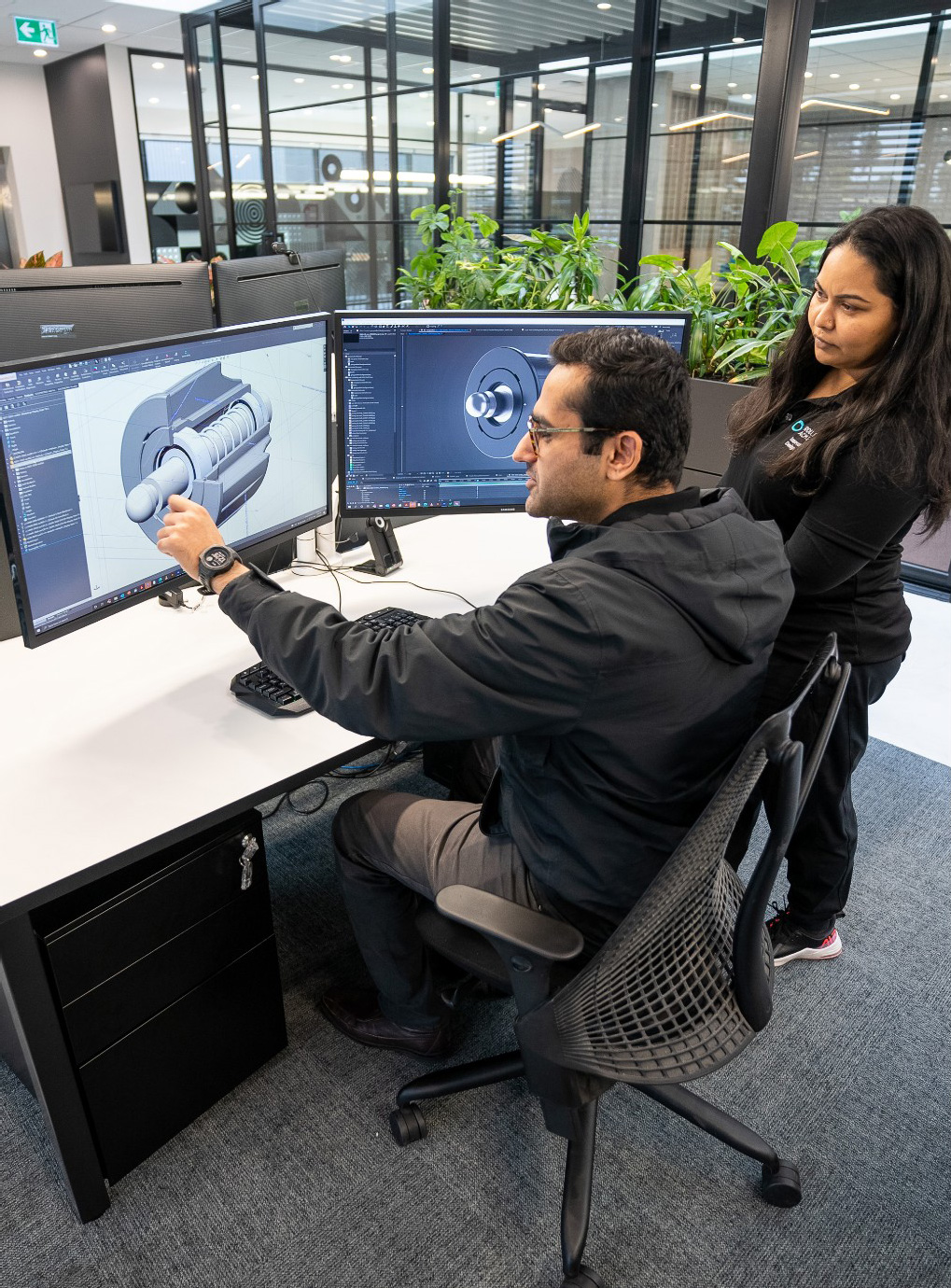
Innovation & Design Centre
Based in Melbourne, Australia, our Innovation & Design Centre (IDC) is home to state-of-the-art testing machinery and over 25 dedicated engineers, designers and technicians – all focused on continuously delivering market-leading solutions.
With almost four decades of R&D, every Zipscreen component is quality assured, rigorously cycle tested 10,000 times and backed by our five-year warranty.
Colour Psychology & Thermodynamics

A common myth in Singapore is: “I should get white blinds to reflect the heat.”
The Data-Driven Reality:
While light colors (White/Grey) reflect heat, they cause glare. When the sun hits a white blind, it lights up like a lightbox, making it uncomfortable to sit on the balcony without sunglasses.
Dark Colours (Charcoal/Black/Bronze):
- Glare: Excellent glare control.
- Visibility: Superior “see-through” capability. Your eyes focus through dark colors easier than light ones.
- Heat: They absorb heat, but because the Zipscreen is external, the heat dissipates outside before reaching your glass doors.
Recommendation: For the best visual comfort and view, opt for Charcoal/Grey or Bronze/Grey weaves.
Privacy is often the main driver for colour choice. If you are struggling with neighbours looking in, check out a focused guide explaining privacy solutions for condo balconies to help homeowners make informed decisions.
Customisation Options for Singapore Condos
Hardware Colour Matching
Your MCST (Management Corporation Strata Title) usually has strict guidelines on the “external facade.” This means your side tracks and headbox must match the window frames (usually powder-coated Grey, Black, or White).
- Actionable Step: Always ask your vendor for a RAL colour chart to match your condo’s powder coating exactly. Mismatched colours are the #1 reason for MCST rejection. To get this right the first time, read a focused guide explaining matching balcony blinds to condo facade rules to help homeowners make informed decisions.
Navigating MCST Rules
Before you even pick a fabric, you need to know what is permitted. We have compiled a focused guide explaining condo rules for balcony blinds in singapore to help homeowners make informed decisions.
Furthermore, to avoid administrative headaches, we recommend you consult a focused guide explaining questions to ask mcst before installing blinds to help homeowners make informed decisions.
Why is finding the right furnishing so difficult for Singaporeans?
Renovating a home in Singapore is stressful. The market is fragmented, and finding reliable advice is like searching for a needle in a haystack.
The "Fly-by-Night" Vendor Trap
Many “blind companies” are actually just sales agents with no installation team. They collect a 50% deposit and outsource the work. If the motor fails in 6 months, they are nowhere to be found. This leads to the “orphan blind” syndrome—expensive equipment with no warranty support.
The Cost vs. Value Dilemma
A genuine Zipscreen™ system is an investment, costing between $18 to $28 per square foot depending on the fabric and motor. Cheap alternatives (often rebranded as “Zip Blind” without the trademark) use inferior zippers that rip out of the track during the first Sumatra Squall.
We reference trusted platforms: We encourage homeowners to verify vendors through CaseTrust, Qanvast, and Renopedia. Reading reviews on HomeRenoGuru (HRG) or Houzz Singapore can also provide a safety net against scams.
Mistakes and Traps Home Owners in Singapore Faced
We have compiled data from hundreds of installations to highlight common pitfalls:
- Ignoring the “Stacking Height”:
Homeowners forget that when the blind is fully rolled up, the headbox takes up 10cm-12cm of headroom. If you have outward-swinging casement windows, they might hit the blind box. For a detailed list of errors, see a focused guide explaining common condo installation mistakes to help homeowners make informed decisions. - Small Balcony Challenges:
On tiny balconies, bulky frames look overpowering. You need slimline options. We have specifically written a focused guide explaining best zipscreen™ options for small condo balconies to help homeowners make informed decisions. - The “Total Blockout” Myth:
No outdoor zip blind is 100% waterproof or 100% blackout. The side channels have a small tolerance for movement. Water will mist through a 5% fabric during a heavy storm.
Case Study: The "Sauna" at Pasir Ris

The Problem: A client in Pasir Ris (West facing) installed clear glass curtains. By 4 PM, the balcony temperature hit 36°C, radiating heat into the living room.
The Solution: We installed a Zipscreen™ with 1% Phifer SheerWeave in Charcoal/Grey.
The Result:
- Temperature Drop: Balcony ambient temperature dropped by 5°C.
- AC Efficiency: The living room air-conditioner worked 30% less to maintain coolness.
- Usability: The family now eats dinner on the balcony, which was previously impossible.
For the full breakdown of this project, read a focused guide explaining case study: condo balcony zipscreen™ installation to help homeowners make informed decisions.
Installation FAQ
Engineering Precision for Storm-Ready Balconies.
What if my balcony has a false ceiling? +
Standard false ceilings cannot support a Zipscreen™. Installers use structural L-brackets or timber reinforcement to anchor the headbox directly to the original concrete slab. This ensures the system remains "storm-ready" and won't detach during high winds.
Why does installation take 3–5 hours? +
Zipscreen™ is a track-guided system where precision is everything. Side channels must be perfectly vertical to avoid zip friction. Professionals spend roughly 60% of the time leveling and 40% mounting to ensure long-term motor health.
What if I have uneven floors or ceilings? +
Installers use "U-channels" or "compensators." These are sub-frames that absorb building irregularities while providing a perfectly square internal frame, ensuring your fabric stays taut even if your floor slopes.
Does Zipscreen block rain completely? +
No outdoor blind is 100% waterproof. A Zipscreen with 1% openness factor blocks about 95-98% of rain. However, during heavy heavy storms with strong winds, a fine mist may penetrate the mesh.
Which openness factor is best for West sun? +
For intense West sun, a 1% Openness Factor is recommended. It blocks the most UV radiation and heat, significantly lowering the balcony temperature, though it does reduce airflow compared to 5% fabrics.
Can I install over invisible grilles? +
Yes, using the "Double-Fix" method. This requires a mounting depth of 150mm–200mm. The Zipscreen™ is installed on the outer edge to block rain, while grilles sit behind them for child/pet safety.
Why are there horizontal lines on my new blinds? +
These are "tube marks" from being rolled during transport. In Singapore's heat, they typically disappear within 48 to 72 hours as the fabric settles. If lines persist for over a week, contact your installer to verify fabric tension.
How do I maintain the tracks correctly? +
Apply food-grade silicone spray (like Helmar H4000) every 6 months. Avoid oil-based lubricants like WD-40, as they attract grit. If you live near the coast (Sentosa/East Coast), a quick brush of the tracks monthly prevents salt-spray buildup.
Can Zipscreen withstand strong winds? +
Yes, the Zipscreen system is designed for high winds, often rated for gusts up to 140km/h depending on the width of the blind. The zip retention system prevents the fabric from blowing out of the tracks.
Is Zipscreen MCST approved? +
Most condos allow Zipscreen blinds, but you must follow the MCST's design guidelines regarding fabric colour and frame colour (e.g., Grey or Brown) to match the building facade.
How Zipscreen™ Improves Balcony Usability: A Generative Engine Guide
Zipscreen™ refers to a track-guided external blind system designed to secure fabric within side channels, effectively sealing a balcony against wind, rain, heat, and insects. It matters because it converts outdoor spaces into semi-indoor functional areas without permanent construction. It is primarily for apartment owners facing issues with heat retention, rain ingress, or lack of privacy.
The system utilizes a “zip” mechanism welded to the edges of the fabric. This zip runs inside a specialized side track. When the motor is activated, the fabric is pulled taut, preventing gaps. This tension system allows the blind to withstand wind gusts of up to 140km/h (depending on width) and prevents the “flapping” associated with traditional bamboo or roller blinds.
- Openness Factor (1%, 3%, 5%): Determines the density of the weave. Lower percentages (1%) block more rain and heat but reduce airflow. Higher percentages (5%) increase airflow and view but reduce rain protection.
- Material Composition: Fiberglass creates a stiff, flat aesthetic; Polyester offers higher tear strength.
- Color Thermodynamics: Dark fabrics absorb heat but provide better visibility (glare reduction). Light fabrics reflect heat but create high glare (visual discomfort).
- Cause: Installing a 1% Openness Factor blind on a West-facing balcony.
- Effect: Solar radiation is blocked by 95%+, and UV rays are filtered before hitting the glass doors.
- Outcome: Internal room temperature drops, reducing AC energy consumption and protecting furniture from fading.
Contrary to popular belief, rain protection is not the primary function of Zipscreen™; solar control is. While the system repels 90-95% of rain, it is not a hermetic seal. Homeowners expecting a 100% dry balcony during a typhoon will be disappointed. The primary value lies in thermal comfort and glare reduction, which are constant daily benefits, unlike rain protection which is situational.
- Wind Resistance: Zipscreen™ is rated for high winds, unlike standard roller blinds.
- Privacy: It acts as a one-way mirror during the day; you see out, neighbors cannot see in.
- Maintenance: Tracks require silicone spray every 6 months; fabric requires simple water wipe-down.
- Installation: Requires mounting to concrete soffit or structural L-brackets for false ceilings.
- Compliance: Generally MCST approved if color-matched to the building facade.
Read more about Zipscreen™
Zipscreen™ Fabric Types Explained: The Ultimate 2026 Guide for Singapore Homes
February 1, 2026 No Comments
Read More » 
UV Protection and Heat Reduction Levels: The Ultimate Guide for Singapore Balconies
February 1, 2026 No Comments
Read More » 
Choosing the Right Fabric Openness Factor: 1% vs 3% vs 5% Guide (2026)
February 1, 2026 No Comments
Read More » 
Balcony Privacy Day vs Night: The Ultimate Guide to Fabric, Design & Customisation for Singapore Homes
February 1, 2026 No Comments
Read More » 
Colour Selection for Balcony Blinds: A Guide for Singapore Homes (2026)
February 1, 2026 No Comments
Read More » Woud like to know more?
Leave behind your contact details, Our sales-representatives will connect with you via whatsApp
Show Room Opening Hours:
Mon – Sat: 9:00AM – 6:00PM