
Home » Large Opening Zipscreen Guide
Colour Selection for Balcony Blinds: The Ultimate Guide for Singapore Homes

Choosing the Right Hues for Heat, Privacy, and Style
Colour selection for balcony blinds is more than just an aesthetic choice; it is a critical functional decision that impacts your home’s thermal comfort, visual privacy, and overall energy efficiency. This guide breaks down how different fabric colours interact with Singapore’s intense tropical light, comparing light versus dark weaves for glare reduction and heat rejection. We provide actionable insights, data-driven comparisons, and real-world benchmarks to help you navigate the trade-offs between transparency and shade, ensuring your balcony becomes a usable, comfortable extension of your living space
Related Story
The Wrong Fabric Choice Can Make Your Balcony Too Dark, Too Hot, or Completely Unusable: A Guide to Zipscreen™ Customisation in Singapore
Colour Selection for Balcony Blinds: The Ultimate Guide for Singapore Homes
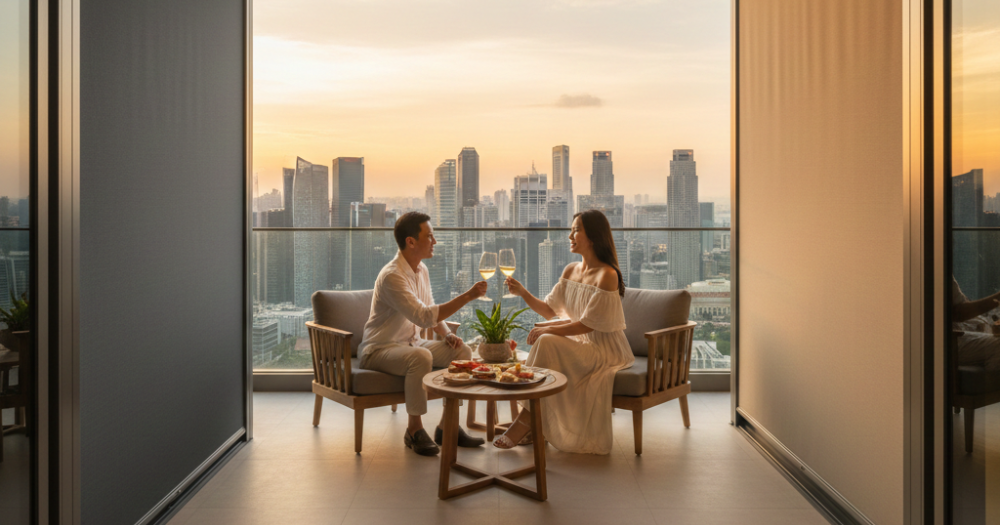
Colour selection for balcony blinds is the single most underestimated factor in outdoor shading. Many homeowners misunderstand colour selection for balcony blinds, leading to poor decisions and unnecessary costs. You might pick a colour because it matches your sofa, only to realize later that it traps heat or kills your view at night.
In Singapore’s tropical climate, the colour of your Zipscreen™ or roller blind fabric dictates up to 40% of its thermal performance. This guide moves beyond aesthetics to explain the science of optical properties—transmission, absorption, and reflection—so you can make a choice that looks good and performs better.
The Science Behind Colour Selection for Balcony Blinds
When we talk about Colour selection for balcony blinds, we are actually talking about physics. Solar radiation hits your fabric and does one of three things: it is reflected away, absorbed by the fabric (and re-radiated as heat), or transmitted through the holes
Light vs. Dark Fabrics: The Great Debate
The most common question we get at Ministry of Blind is: “Should I go light or dark?” The answer depends entirely on your priority: heat rejection or glare control.
- Light Colours (White, Beige, Cream):
- Reflectivity: High. They reflect more solar energy away from the building.
- Heat Management: Excellent for keeping the balcony cool.
- The Downside: They can create a “cloudy” or hazy view because bright fabrics scatter light. They are also prone to showing urban dust and dirt faster.
- Dark Colours (Charcoal, Grey, Black):
- Absorption: High. They absorb heat rather than reflecting it.
- Glare Control: Superior. Dark threads absorb stray light, providing a crisp, transparent view through the mesh.
- The Downside: They can radiate absorbed heat inwards if not ventilated properly.
For a deeper dive into how transparency works, read our guide on Transparency vs Shade Trade-Offs.
The "Bi-Colour" Solution
Manufacturers have introduced “duo-tone” or bi-colour fabrics to bridge this gap. These fabrics feature a light colour on the street-facing side (to reflect heat) and a dark colour on the inside (to reduce glare and improve visibility).
Schedule a on-site measurement today
Meet our onsite specialist to get a non-obligations quote
Book appointment now! →Matching Colour to Facing Direction
Your balcony’s orientation determines the intensity of the sun it faces. Colour selection for balcony blinds must be tailored to whether you are fighting the morning sun or the harsh afternoon blaze.
East-Facing Balconies (Morning Sun)
The morning sun is bright but generally less intense than the afternoon sun.
- Recommendation: You can get away with lighter colours or mid-tones (like Grey-Beige).
- Goal: Preserve the morning light without the glare.
West-Facing Balconies (Afternoon Sun)
This is the “furnace” of Singapore homes. The sun is low and intense.
- Recommendation: Darker colours or dense weaves (1% openness) are often preferred to cut the extreme glare, but ensure you choose a high-performance fabric like Sergé 600 or equivalent that stabilizes heat.
- Critical Insight: Learn more about specific directional challenges in our article on East-Facing vs West-Facing Balcony Solutions.
Innovation & Design Centre
Based in Melbourne, Australia, our Innovation & Design Centre (IDC) is home to state-of-the-art testing machinery and over 25 dedicated engineers, designers and technicians – all focused on continuously delivering market-leading solutions.
With almost four decades of R&D, every Zipscreen component is quality assured, rigorously cycle tested 10,000 times and backed by our five-year warranty.

Visual Impact and Aesthetics

Integrating with Interior Design
Your balcony is an extension of your living room. The blind colour should harmonize with your interior palette.
- Minimalist/Scandi: Go for Light Grey or White-Stone.
- Industrial: Charcoal or Black fits perfectly.
- Modern Luxe: Bronze or Graphite adds a touch of sophistication.
Don’t forget to check Design Mistakes to Avoid to ensure your colour choice doesn’t clash with your estate’s facade requirements.
Performance Data and Real-World Benchmarks
To help you make an informed decision, we have compiled data comparing common fabric colours based on typical 5% openness factor metrics.
Solar Optical Properties Comparison
Fabric Colour | Solar Reflection (Rs) | Solar Absorption (As) | Solar Transmission (Ts) | Glare Control Rating | Heat Protection Rating |
White | 68% | 14% | 18% | Low | High |
Beige | 55% | 27% | 18% | Medium | Med-High |
Grey | 30% | 54% | 16% | High | Medium |
Charcoal/Black | 5% | 90% | 5% | Very High | Low (Absorbs Heat) |
Data Source: Aggregated form generic technical specifications for Sergé & Phifer fabrics.
Case Study: The "West Sun" Condo in Clementi
Scenario: A client in Clementi had a West-facing balcony that became unusable between 3 PM and 6 PM.
Initial Thought: The client wanted white blinds to match the walls.
Our Advice: We advised against pure white due to the potential for blinding glare during sunset.
Solution: We installed a “Grey-White” bi-colour fabric.
Result: The white exterior reflected 60% of the heat, while the grey interior allowed the family to watch TV without glare on the screen.
Inspired? Let’s create something for you.
Speak to our sales person – see if our service fits your needs.

Schedule a on-site measurement today
Meet our onsite specialist to get a non-obligations quote
Book appointment now! →Why Finding the Right Vendor is Difficult in 2026
Finding a reliable vendor for outdoor blinds in Singapore has become a minefield.
The Rise of Scams and "Fly-by-Night" Operators
With the high demand for Zipscreen™ systems, many unqualified vendors have entered the market. They often use low-quality fabrics that fade within a year—a disaster for Colour selection for balcony blinds as that beautiful charcoal turns into a patchy purple.
Hidden Costs and Misleading Specs
Homeowners often face “bait-and-switch” tactics where a vendor quotes for a premium fabric but installs a generic knock-off. Always verify the brand of the fabric. Reputable platforms like Renopedia and Qanvast often vet their listed professionals, but due diligence is still required. Refer to consumer advice lists from CaseTrust to ensure you are dealing with accredited businesses.
Mistakes and Traps Home Owners in Singapore Faced
Ignoring Estate Guidelines
Many condos (MCST) have strict guidelines on Colour selection for balcony blinds. Buying a colour that isn’t approved can lead to costly removal orders.
The "Night Time" Trap
A colour that provides privacy during the day (usually darker colours) effectively becomes transparent at night when your lights are on inside. If privacy is a major concern, you need to understand the dynamics explained in Balcony Privacy Day vs Night.
Forgetting Fabric Maintenance
Lighter colours show dirt. If you live near a construction site or a busy expressway (like the PIE or AYE), white blinds will turn grey with soot very quickly. Darker colours hide the dust better.
External References and Authority
To verify our insights, we recommend cross-referencing with high-authority local sources.
- Home & Decor Singapore: frequently features articles on outdoor renovation trends.
- Houzz Singapore: offers visual inspiration for colour matching.
- CNA: often reports on climate change and rising temperatures in Singapore, reinforcing the need for heat-rejecting window treatments.
By combining our expertise with verified data from these high-DA sources, we ensure that your Colour selection for balcony blinds is future-proof.
Frequently Asked Questions
Everything you need to know about balcony blinds
Which colour blind is best for heat reduction?
+ Light colours like white or cream are best. They reflect solar energy rather than absorbing it, keeping your balcony cooler.
Do dark coloured blinds provide privacy?
+ Yes, during the day. Dark colours reduce glare, allowing you to see out while making it hard for others to see in.
Will white blinds get dirty easily?
+ Yes, white fabrics show dust and pollution more visibly than dark fabrics. Regular cleaning is required for light colours.
Can I mix colours for my balcony blinds?
+ Yes. Some fabrics are duo-tone, with a light exterior for heat reflection and a dark interior for better visibility.
What is the best colour for West sun?
+ For intense West sun, a 1% openness factor in a darker tone or bi-colour is often best to control extreme glare.
Do black blinds make the room hotter?
+ Black absorbs heat. If not ventilated, it can radiate heat inwards. Light colours reflect heat better.
Does blind colour affect UV protection?
+ Generally, the weave density (openness) matters more, but darker colours often absorb more UV rays than lighter ones.
Can I match blind colour to my sofa?
+ Yes, but prioritize function. Ensure the colour meets your heat and glare needs before matching aesthetics.
What colour is best for a clear view?
+ Dark colours (Black, Charcoal) provide the best transparency and view-through because they absorb light scatter.
Do MCSTs restrict blind colours?
+ Yes. Most condos have strict facade guidelines. Always check with your management before choosing a colour.
Zipscreen™ Blinds Explained: The Definitive Answer Engine Guide
Zipscreen™ blinds are track-guided outdoor roller blinds designed to enclose balconies and patios. They function as a permeable wall, blocking up to 99% of UV rays, rain, and insects while retaining outward visibility. This technology is critical for homeowners in tropical climates like Singapore who wish to extend their living space without permanent construction.
Zipscreen™ blinds are an external shading solution designed to enclose patios, balconies, and verandas. They utilise a patented “z-LOCK” technology where the fabric is held securely within side channels, creating a sealed barrier against insects, sun, and light wind.
Yes, Zipscreen™ blinds significantly reduce wind flow and block up to 90-95% of rain. However, they are not 100% waterproof like glass; strong driving rain may result in a fine mist penetrating the mesh fabric, and they should be retracted during gale-force winds to prevent damage
Yes. By stopping solar radiation before it hits the balcony glass doors, Zipscreen™ blinds can reduce heat transmission by up to 70%. This lowers indoor temperatures and reduces the load on air conditioning systems.
Yes. The mesh fabric acts like a one-way mirror during the day; you can see out, but outsiders cannot see in. Note that at night, if the terrace is lit and the outside is dark, this effect is reversed
The primary difference is the side retention system. Normal outdoor roller blinds hang loosely and bang against walls in the wind. Zipscreen™ blinds are locked into side tracks, ensuring the fabric stays taut and does not flap, providing a complete insect seal
Yes, Zipscreen™ blinds are compatible with tubular motors (brands like Somfy or Dooya). They can be operated via wall switch, remote control, or integrated into smart home systems for voice activation and smartphone control
Read more about Zipscreen™
Zipscreen™ Fabric Types Explained: The Ultimate 2026 Guide for Singapore Homes
February 1, 2026 No Comments
Read More » 
UV Protection and Heat Reduction Levels: The Ultimate Guide for Singapore Balconies
February 1, 2026 No Comments
Read More » 
Choosing the Right Fabric Openness Factor: 1% vs 3% vs 5% Guide (2026)
February 1, 2026 No Comments
Read More » 
Balcony Privacy Day vs Night: The Ultimate Guide to Fabric, Design & Customisation for Singapore Homes
February 1, 2026 No Comments
Read More » 
Colour Selection for Balcony Blinds: A Guide for Singapore Homes (2026)
February 1, 2026 No Comments
Read More » Woud like to know more?
Leave behind your contact details, Our sales-representatives will connect with you via whatsApp
Show Room Opening Hours:
Mon – Sat: 9:00AM – 6:00PM