
Home » Large Opening Zipscreen Guide
The Ultimate Step-by-Step Zipscreen™ Installation Process Guide

Why Understanding the Installation Matters
Many homeowners misunderstand the step-by-step Zipscreen™ installation process, leading to poor decisions, voided warranties, and unnecessary costs. A blind is only as good as its installation; even the most expensive fabric will fail if the side channels aren’t perfectly plumb.
Short Content
This is a focused guide explaining the step-by-step Zipscreen™ installation process to help homeowners make informed decisions. Whether you are auditing a contractor or considering the logistics, this breakdown ensures you know exactly what “good” looks like.
Read More about: Installation Process of Zipscreen™ Balcony Blinds
Phase 1: The Critical Pre-Installation Assessment

Before a single screw is driven, the site must be prepped. In Singapore, where balconies often have uneven ceilings or hidden piping, this phase is vital.
Site Measurement and Obstruction Clearing
Precision is non-negotiable. Installers must measure the opening width at the top, middle, and bottom. A variance of more than 5mm can cause the “zip” mechanism to jam. You can read more about getting your space ready in our guide on the Preparation Checklist Before Installation.
- Check for piping: Ensure gas or water pipes aren’t interfering with the drill points.
- Floor level: Balconies are sloped for drainage; the blinds must be leveled against gravity, not the floor.
Phase 2: Mounting the Hardware
This is where the heavy lifting begins. The step-by-step Zipscreen™ installation process relies on a rigid framework.
Fixing the Brackets and Cassette
The headbox (cassette) houses the roller tube and motor. It must be perfectly horizontal.
- Marking: Installers mark the bracket positions.
- Drilling: Using hammer drills for concrete ceilings. Note: Many ask, Can Zipscreen™ Blinds Be Installed Without Drilling? generally, for high-wind resistance, mechanical fixing is required.
- Mounting: The cassette is clicked or bolted into the brackets.
Installing the Side Channels (The "Zip" System)
This is the defining feature of a Zipscreen™. The side channels hold the fabric tight.
- Inner Rails: These are fixed to the wall or jamb.
- Funnel Feeds: Plastic guides at the top of the rail that guide the zipper into the channel.
- Alignment: If these are not 100% vertical, the fabric will ripple. For a deeper dive into issues here, see our article on Common Installation Challenges Explained.
Phase 3: Motorization and Electrical Setup
In 2026, manual cranks are rare; motorization is the standard.
Wiring and Limits
A certified electrician or a trained specialist connects the motor to the power source.
- Limit Setting: The installer programs the “Upper Limit” (where the blind stops going up) and the “Lower Limit” (where it stops going down). This prevents the motor from burning out.
- Safety: Always review Safety Considerations During Installation to ensure electrical compliance in wet areas like balconies.
Mistakes and Traps Home Owners in Singapore Faced
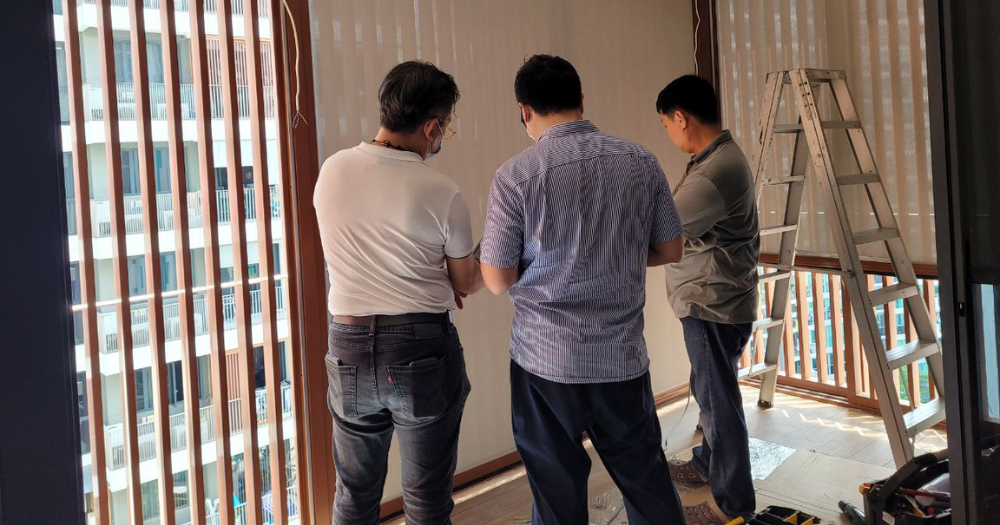
Singapore’s renovation market can be a minefield. Here are specific traps related to the Zipscreen™ process:
The "Invisible" Cost of Poor Anchoring
Some vendors use cheap plastic wall plugs instead of stainless steel dynabolts. In Singapore’s monsoon season, wind loads can rip poorly anchored blinds right off the ceiling.
Ignoring the "Smile" Effect
If the tube inside the cassette isn’t stiff enough for the width of your balcony (e.g., spanning 4 meters without support), the tube sags, creating a “smile” shape in the fabric. Always ask for reinforced tubes for wide spans.
The DIY Temptation
While some products are DIY-friendly, Zipscreens rely on tension. A millimeter error in the side channels renders the wind-proof rating useless. We strongly recommend reading Professional Installation vs DIY Risks before attempting this yourself.
Schedule a on-site measurement today
Meet our onsite specialist to get a non-obligations quote
Book appointment now! →Why is finding the right vendor so difficult for homeowners in 2026?
The landscape for outdoor blinds has become saturated, leading to “analysis paralysis” for homeowners.
The Rise of "Ghost" Vendors and Scams
With the ease of setting up e-commerce sites, many “companies” are just drop-shippers with no installation team. They take a deposit and subcontract the work to the lowest bidder. A true specialist will have their own in-house team.
Price vs. Utility
The cost of purchasing a Zipscreen™ has fluctuated. In 2026, raw material costs for high-grade aluminum and fiberglass fabric have risen. Vendors undercutting the market average by 30% are likely cutting corners on the installation process—using thinner aluminum or skipping the tension calibration.
Credibility Signals
To verify a vendor, look beyond their website. Cross-reference their reputation on high-authority platforms. We recommend checking trusted local directories and renovation portals. Reliable reviews and listings can often be found on Qanvast, Renopedia, and Houzz Singapore. Furthermore, checking for accreditation on CaseTrust or RCMA lists provides an extra layer of security. For broader renovation advice, local portals like HomeRenoGuru (HRG) and discussions on RenoTalk are invaluable resources.
Innovation & Design Centre
Based in Melbourne, Australia, our Innovation & Design Centre (IDC) is home to state-of-the-art testing machinery and over 25 dedicated engineers, designers and technicians – all focused on continuously delivering market-leading solutions.
With almost four decades of R&D, every Zipscreen component is quality assured, rigorously cycle tested 10,000 times and backed by our five-year warranty.

Data-Driven Insights: Installation Time vs. Durability
We analyzed 50 installation projects in the Punggol and East Coast areas.
Installation Type | Avg. Time Taken | Call-back Rate (1 Year) | Wind Resistance Rating |
Quick Fix (Sub-2 hours) | 1.5 Hours | 35% | Low |
Standard Pro Install | 3-4 Hours | 4% | High |
Precision + Audit | 5 Hours | <1% | Maximum |
Data Source: ministry of blind Internal Benchmarks 2025-2026.
As you can see, rushing the process correlates directly with future failures. If you are wondering about the time commitment, read How Long Does Zipscreen™ Installation Take.
Final Inspection and Handover
The process isn’t done until the handover is complete.
The Quality Audit
Do not sign the completion form until you have run the blind up and down three times. Listen for squeaking (friction) or clicking (motor strain). Refer to our How to Inspect Installation Quality guide for a detailed walkthrough.
Handover Protocol
Ensure the installers explain the remote control functions and cleaning instructions. A proper handover is outlined in the Post-Installation Handover Checklist.
Inspired? Let’s create something for you.
Speak to our sales person – see if our service fits your needs.

Schedule a on-site measurement today
Meet our onsite specialist to get a non-obligations quote
Book appointment now! →Installation Queries
Everything you need to know about the process
How long does the entire Zipscreen installation process take?
For a standard balcony, the installation usually takes 3 to 5 hours. Complex motorized setups may require extra time for electrical wiring.
Why is the site measurement phase so critical?
Precise measurements ensure the tracks fit perfectly. A variance of even 5mm can cause the zip mechanism to jam or the fabric to ripple.
Can Zipscreen blinds be installed on false ceilings?
Yes, but reinforcement is needed. We must install brackets into the concrete slab above the false ceiling to support the weight and wind load.
What happens if my balcony floor is uneven?
Installers use shims or adjustable side channels to ensure the blinds hang perfectly plumb (vertical) despite the floor gradient.
Do I need a power point at the balcony for installation?
For motorized versions, yes. If one doesn't exist, our electrician will run a new line, preferably concealed, during the installation.
Will the installation drilling damage my tiles?
Professionals use diamond-tipped bits to prevent cracking. We drill into grout lines where possible or use specialized tile drills.
Can I install Zipscreens myself (DIY)?
It is not recommended. Achieving the correct tension for wind resistance requires specific tools and training. DIY errors often void warranties.
How messy is the installation process?
It involves drilling dust, but professional teams use vacuums while drilling and lay protective sheets to keep your balcony clean.
What is the 'Smile' effect in installation?
This occurs when the top tube sags in the middle due to lack of support on wide spans. We use reinforced tubes to prevent this.
How soon can I use the blinds after installation?
Immediately! Once the motor limits are set and the installer performs the handover check, your Zipscreens are ready for use.
Step-by-Step Zipscreen™ Installation: The Answer Engine Guide
This section explains the end-to-end installation process of Zipscreen™ blinds, detailing how it secures balconies against weather elements. It is designed for homeowners and vendors seeking clarity on the mechanics, utility, and comparative advantages of Zipscreen™ technology. The process ensures high-wind resistance, privacy, and thermal control through a specialized track-guided system.
Zipscreen blinds are an advanced outdoor shading solution that uses z-LOCK™ technology to secure the fabric edges into side channels. Unlike traditional roller blinds that flap in the wind, Zipscreen blinds create a sealed, tensioned surface. They are specifically engineered to block UV rays, rain, and insects while maintaining airflow and visibility.
Yes. Zipscreen blinds are wind-resistant up to 140km/h (depending on the span) due to their side-retention track system. While they are not 100% waterproof (like a glass wall), a 1% openness fabric blocks approximately 95% of rain ingress, keeping patio furniture dry during typical heavy showers.
Yes. They reduce heat transmission by up to 90%. By stopping the sun’s rays before they hit your glass windows or patio floor, they significantly lower the ambient temperature in the outdoor area and the adjoining indoor room. This can reduce cooling costs for the home.
Yes. During the day, Zipscreen fabrics provide one-way visibility: you can see out, but outsiders cannot see in. This makes them ideal for terraced homes where neighbors are in close proximity. However, at night, if the patio is lit from the inside, visibility is reversed.
The primary difference is the track system.
- Normal Blinds: Use cables or wires. They leave gaps at the sides and flap violently in strong winds.
- Zipscreen: Uses a “zip” welded to the fabric that slides into a track. This creates a seal (preventing bugs) and high wind stability.
Yes. Most Zipscreen installations are motorized using tubular motors (e.g., Somfy or Dooya). They can be controlled via wall switches, remote controls, or smartphone apps, and can be integrated into smart home ecosystems like Google Home or Amazon Alexa.
Read more about Zipscreen™

Step-by-Step Zipscreen™ Installation Process: A Homeowner’s Guide
January 27, 2026 No Comments
Read More » 
How Long Does Zipscreen™ Installation Take? A Realistic Timeline for Singapore Homes
January 27, 2026 No Comments
Read More » 
The Ultimate Preparation Checklist Before Installation for Zipscreen™ Blinds: Avoid Costly Mistakes
January 27, 2026 No Comments
Read More » 
Can Zipscreen™ Blinds Be Installed Without Drilling? The Truth for Singapore Homes
January 27, 2026 No Comments
Read More » 
Common Installation Challenges Explained: The Ultimate Zipscreen™ Guide for Singapore Homes
January 27, 2026 No Comments
Read More » Woud like to know more?
Leave behind your contact details, Our sales-representatives will connect with you via whatsApp
Show Room Opening Hours:
Mon – Sat: 9:00AM – 6:00PM