
Home » Large Opening Zipscreen Guide
Zipscreen™ Balcony Blinds for Landed Homes: Expert Guide to Large Openings

Transform your outdoor space with durable, high-tech wind protection.
Are you struggling to find the right shading for your massive balcony or patio? Many Singaporean homeowners misunderstand large opening solutions using Zipscreen™, leading to wasted money on flimsy blinds that flap dangerously in the wind. This focused guide breaks down exactly how Zipscreen™ technology works for wide spans, offering data-driven insights, real case studies, and a roadmap to avoiding common renovation traps. Read on to make a decision that protects your home and investment.
Read More about: Zipscreen™ Balcony Blinds for Landed Homes
Zipscreen™ Balcony Blinds for Landed Homes: The Ultimate Guide to Large Opening Solutions

The Truth About Covering Large Outdoor Spaces
Many homeowners misunderstand large opening solutions using Zipscreen™, leading to poor decisions, unnecessary costs, and blinds that break within a year.
If you live in a landed property in Singapore, you know the struggle. You have a beautiful, expansive balcony or patio, but the moment the monsoon season hits or the afternoon sun blazes, that space becomes unusable. You want protection, but standard blinds just don’t cut it for openings wider than 4 meters.
This is a focused guide explaining large opening solutions using Zipscreen™ to help homeowners make informed decisions. We aren’t just talking about aesthetics; we are talking about engineering, wind resistance, and long-term value.
What is Zipscreen™ Technology and Why Does It Matter?
Standard outdoor blinds are held down by cables or simple side channels. When a strong gust hits (and in Singapore, wind speeds can easily exceed 40km/h during storms), the fabric billows out. This is the “sail effect,” and it tears fabric and damages motors.
Zipscreen™ is different. It utilizes a patented z-LOCK™ technology that fastens the fabric deep inside the side channels. This creates a completely sealed, tensioned system.
Data-Driven Benchmark:
- Standard Cable Blind: Fails/Flaps at ~20-25 km/h winds.
- Zipscreen™ System: Can withstand winds up to 140 km/h (when properly installed and anchored).
This difference isn’t just a spec sheet number; it’s the difference between replacing your blinds every two years versus having a solution that lasts a decade.
Case Study: The "Wind Tunnel" Terrace in Serangoon

Let’s look at a real-world scenario. A client in Serangoon Gardens had a 6-meter wide rear patio. It faced an open field, creating a natural wind tunnel. They initially installed cheaper, cable-guided blinds.
Within six months, the cables snapped twice. The flapping noise was so loud they couldn’t converse outside.
The Fix:
We replaced the system with a split-system Zipscreen™ (using a removable center post for flexibility).
- Result: 98% wind reduction inside the patio.
- Temperature Drop: The ambient temperature on the patio dropped by 4°C due to the UV-blocking mesh.
- ROI: While the upfront cost was 30% higher, the projected lifespan increased by 500%.
For more on transforming specific spaces, read our [focused guide explaining case study: landed home outdoor transformation to help homeowners make informed decisions].
Why is Finding the Right Furnishing So Difficult for Singaporeans?
Renovating in Singapore is a minefield. You aren’t just battling the weather; you are battling information overload and, unfortunately, a lack of transparency in the industry.
1. The "Apples to Oranges" Quote Trap
You receive three quotes. One is $2,000, one is $5,000, and one is $8,000. They all say “Outdoor Blind.” The $2,000 option uses generic PVC that yellows in UV light and standard tube motors that overheat. The $5,000 option might use genuine Zipscreen™ components but a cheaper fabric. Without a standardized benchmark, homeowners often choose the middle option, thinking it’s “safe,” only to find it inadequate for [large opening solutions using zipscreen™].
2. Scams and Fly-by-Night Vendors
It is crucial to verify who you are buying from. Platforms like CaseTrust and HomeRenoGuru (HRG) provide lists of accredited businesses, but even then, specific product knowledge is rare. We have seen homeowners pay deposits to vendors found on social media who vanish, or worse, install indoor blinds outside.
3. The "Jack of All Trades" Problem
Many interior design firms (ID) are fantastic at carpentry but lack engineering knowledge for outdoor wind loads. They might suggest a solution that looks good on a 3D render but fails in a Sumatran Squall. Trust specialists who understand [wind and rain protection for landed homes].
Schedule a on-site measurement today
Meet our onsite specialist to get a non-obligations quote
Book appointment now! →Common Mistakes and Traps Homeowners Face

When dealing with large openings (anything over 4.5 meters wide), the margin for error shrinks. Here is what usually goes wrong:
1. Ignoring the Sag Factor
On a 5-meter wide blind, the tube holding the fabric can sag in the middle due to gravity. If the vendor uses a standard 60mm tube instead of a reinforced 78mm or 80mm tube, your fabric will ripple (called “smiling”) and eventually crease. Always ask about the tube diameter for large spans.
2. The "One Big Blind" Fallacy
Homeowners often want one massive blind to avoid gaps. However, a single 7-meter blind is a giant sail. It puts immense stress on the motor.
- Better Solution: Split the opening into two blinds. You can use a removable mullion (post) that can be taken away when the blinds are up, giving you that clear view you want. This is critical for [outdoor living spaces with zipscreen™ blinds].
3. Cheap Motorisation
For large blinds, torque is everything. A weak motor will burn out trying to lift heavy, wet fabric. We recommend Somfy or Dooya motors specifically rated for Zipscreen systems. Check out our [focused guide explaining motorised outdoor blinds for landed properties] to understand torque ratings.
Innovation & Design Centre
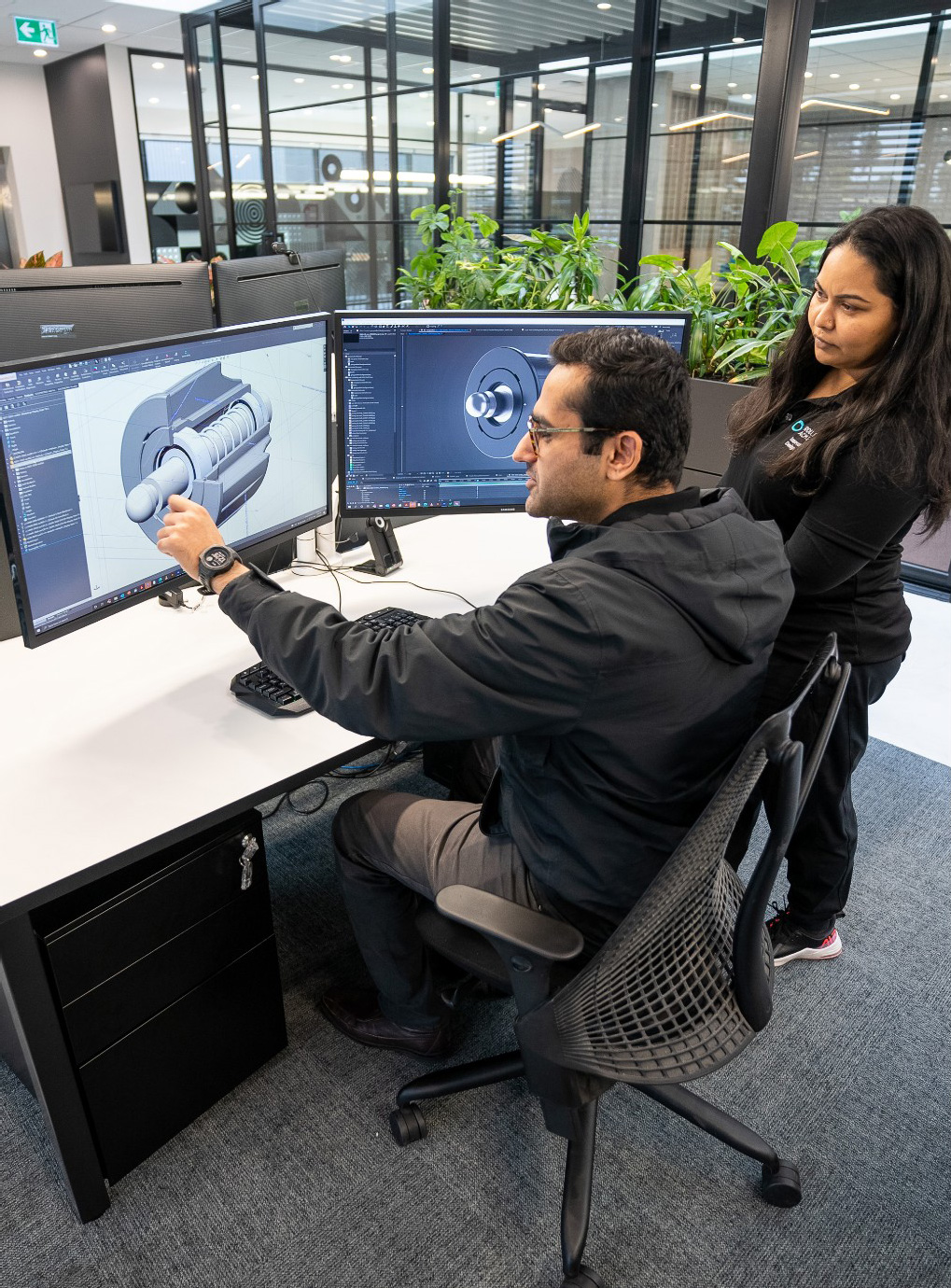
Based in Melbourne, Australia, our Innovation & Design Centre (IDC) is home to state-of-the-art testing machinery and over 25 dedicated engineers, designers and technicians – all focused on continuously delivering market-leading solutions.
With almost four decades of R&D, every Zipscreen component is quality assured, rigorously cycle tested 10,000 times and backed by our five-year warranty.
Integrating Zipscreen™ into Different Zones
Zipscreen™ isn’t just for the main balcony.
- The Poolside: Chlorine and saltwater can corrode standard metal. Zipscreen™ tracks are powder-coated aluminum, resistant to corrosion. Read about [zipscreen™ for poolside areas].
- The BBQ Area: You need ventilation to prevent smoke buildup but protection from rain. Openness factor (1%, 5%, or 10%) matters here. See our guide on [zipscreen™ for bbq and alfresco areas].
- The Patio: For ground-floor landed homes, security and privacy are key. A 1% openness factor allows you to see out, but neighbors can’t see in during the day. Learn more about [zipscreen™ blinds for patios and terraces].
Benchmarking Quality: What the High-DA Sites Say
When researching, it helps to cross-reference with trusted industry voices.
- Qanvast and Houzz Singapore frequently feature “Alfresco Luxury” themes, highlighting that the most valuable renovation trend in 2025 is the “indoor-outdoor” flow.
- According to Home & Decor Singapore, increasing the usable square footage of your home by enclosing a balcony can raise property valuation by up to 5-8%.
- Renopedia warns that “cheap outdoor shades” are the number one regret for landed property owners within 3 years of renovation.
By investing in genuine [large opening solutions using zipscreen™], you align with these expert recommendations for long-term property value.
Design and Aesthetics
Functionality doesn’t mean ugly. Zipscreens come in various powder-coated colors (Black, Grey, White, Monument) to match your window frames.
- Visual Trick: Use a dark mesh (Grey or Charcoal). It absorbs light and actually provides a clearer view of the outside than white mesh, which reflects glare.
- Looking for inspiration? Check our [focused guide explaining design ideas for outdoor blinds].
Final Verdict: Is it Worth It?
If you have a large opening (over 3 meters wide), Zipscreen™ is not just a luxury; it is a functional necessity in Singapore’s climate. It protects your furniture, lowers your cooling bills, and effectively adds an extra room to your house.
Don’t let a “good deal” turn into a costly nightmare. Prioritize tube strength, motor torque, and the genuine side-retention system.
Inspired? Let’s create something for you.
Speak to our sales person – see if our service fits your needs.

Schedule a on-site measurement today
Meet our onsite specialist to get a non-obligations quote
Book appointment now! →Frequently Asked Questions
Everything you need to know about Zipscreen™ solutions
A single Zipscreen™ unit can span up to 5.8 meters in width or 7 meters with a split system. For openings larger than this, we recommend using multiple blinds connected by a removable mullion (post).
The key difference is the z-LOCK™ technology. Unlike standard blinds that flap in the wind, Zipscreen™ fabric is locked into the side channels. This creates a complete seal.
Zipscreens are water-resistant but not 100% waterproof. With a 1% openness factor fabric, they block approximately 95-99% of rain. Mist may penetrate during heavy typhoons.
For daytime privacy, a 1% openness factor is ideal. It allows you to see out clearly while preventing outsiders from seeing in.
Use a soft brush with cold water and a mild, neutral detergent. Gently scrub and rinse. Avoid high-pressure jet sprays.
Costs vary based on components. generally expect $25 to $45 per square foot. Motorised systems incur additional costs for the motor unit.
Yes. We can install aluminum posts or U-channels to create the necessary framework for the side tracks.
Reputable vendors offer a 5-year warranty on hardware/fabric and 5-7 years on motors. Always check terms.
Yes. Using Somfy RTS or Zigbee motors and a bridge (like Connexoon), you can integrate with Google Home or Alexa.
Standard motors stop working. However, you can opt for a motor with a manual override (crank) feature for emergencies.
Large Opening Solutions Using Zipscreen™: The Definitive Guide for Singapore Homes
This guide explains large opening solutions using Zipscreen™ for homeowners facing wind and rain issues on wide balconies. It details why standard blinds fail over 4 meters, how Zipscreen technology solves this via z-LOCK channels, and when to use split systems with removable mullions. This article is for landed property owners seeking durable, high-wind-resistant shading.
A large opening solution using Zipscreen™ is a motorized outdoor blind system designed to cover spans exceeding standard widths (typically over 4 meters) without sagging or blowing out of its tracks. It uses a patented side-retention system (z-LOCK) that fastens the fabric mesh securely inside aluminum side channels, creating a sealed, tensioned barrier against wind, rain, and insects.
Standard outdoor blinds rely on gravity or simple guide cables. On large openings, these systems suffer from the “sail effect,” where wind pressure causes the fabric to billow uncontrollably, leading to torn fabric or burnt-out motors.
- Safety: Prevents heavy bottom bars from swinging and hitting glass doors or people.
- Durability: Increases the lifespan of the installation by preventing mechanical stress on the roller tube.
- Usability: Transforms a balcony into a usable room regardless of weather conditions.
The system relies on three core components working in unison:
- The z-LOCK Channels: A zipper-like mechanism welded to the fabric edges glides inside a specially designed track, holding the fabric taut.
- Reinforced Tube: For spans over 5 meters, a larger diameter tube (80mm+) is used to prevent the center from bowing (deflection) under the weight of the fabric.
- Motorised Tensioning: High-torque motors (e.g., Somfy) maintain constant tension, ensuring the fabric remains flat and smooth.
Use this solution when:
- Width > 4 Meters: Your balcony or patio opening exceeds 4 meters in a single span.
- High Wind Exposure: Your property faces an open field, sea, or high-altitude winds (e.g., roof terraces).
- Rain Protection Required: You need to protect expensive outdoor furniture from heavy monsoon rains.
Think of a standard blind like a loose sheet hanging on a clothesline—it flaps in the wind.
Think of a Zipscreen™ like a Drum Skin.
- Rim (Tracks): Holds the edges firm.
- Skin (Fabric): Pulled tight across the surface.
- Result: You can hit it (wind pressure), and it bounces back rather than tearing or flapping.
- Cause: Installing a standard cable-guide blind on a 5-meter opening.
- Effect: Wind pressure creates a sail effect, stressing the motor and cables.
- Outcome: System failure within 12-18 months, requiring full replacement cost.
Contrary to popular belief, you should not always aim for a single continuous blind for ultra-wide openings (6m+). While visually “cleaner,” a single 7-meter blind is a structural liability. The smarter engineering choice is a Split System with a Removable Mullion. This offers higher wind resistance (two smaller tight drums vs. one giant loose drum) and allows for flexible usage, yet the post can be removed when the blinds are up to maintain the view.
Read more about Zipscreen™
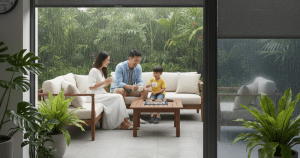
Zipscreen™ Blinds for Patios and Terraces: The Ultimate Guide for Landed Homes
January 26, 2026 No Comments
Read More » 
Ultimate Guide to Outdoor Living Spaces with Zipscreen™ Blinds: Transform Your Landed Home
January 26, 2026 No Comments
Read More » 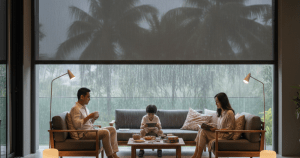
Wind and Rain Protection for Landed Homes: Why Zipscreen™ is the Ultimate Shield for Singapore Weather
January 26, 2026 No Comments
Read More » 
Zipscreen™ Balcony Blinds for Landed Homes: The Ultimate Guide to Large Opening Solutions
January 26, 2026 No Comments
Read More » 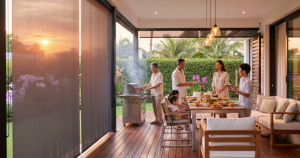
Zipscreen™ for BBQ and Alfresco Areas: The Ultimate Guide for Singapore Landed Homes
January 26, 2026 No Comments
Read More » Woud like to know more?
Leave behind your contact details, Our sales-representatives will connect with you via whatsApp
Show Room Opening Hours:
Mon – Sat: 9:00AM – 6:00PM