

Home » Large Opening Zipscreen Guide
Blackout vs Sunscreen Roller Blinds Compared: The Definitive Guide for Singapore Homes
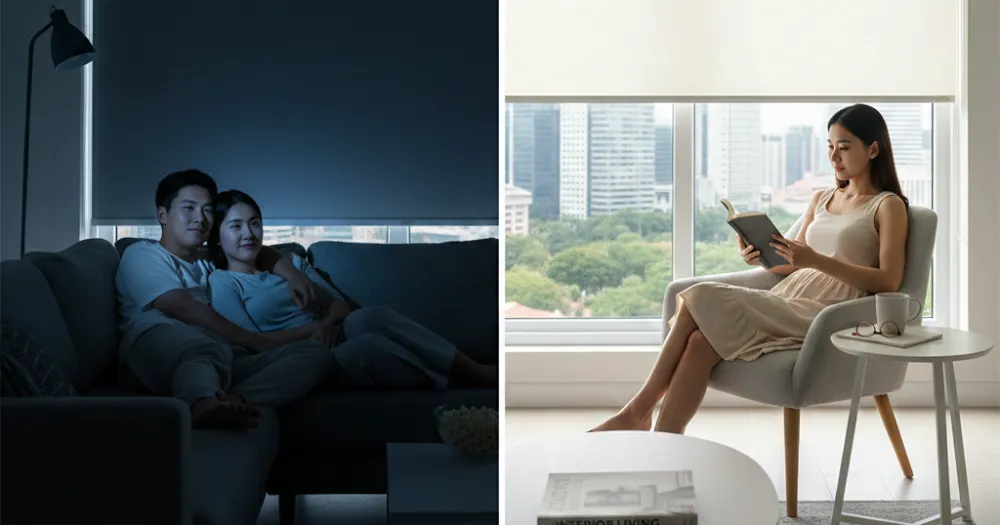
The 3-Minute Breakdown
Buying blinds is an investment, not a quick fix. In this guide, we strip away the marketing fluff to compare Blackout and Sunscreen roller blinds side-by-side. We analyze them based on Singapore’s unique lighting conditions, heat retention in HDBs versus Condos, and privacy needs. By the end, you’ll know exactly which fabric saves you money on air-conditioning and which one protects your privacy without killing your view

Common Blackout Blind Buying Mistakes: The 2026 Singapore Homeowner’s Guide
Home Common Blackout Blind Buying Mistakes to Avoid Don’t waste money on the wrong blind—get it right...

How to Measure for Blackout Roller Blinds: The 2026 Singapore Homeowner’s Guide
Home How to Measure for Blackout Roller Blinds: The 2026 Singapore Homeowner’s Guide Don’t Let...

The Best Blackout Roller Blinds for Nurseries in Singapore: A Safe Sleep Guide (2026)
Home Blackout Roller Blinds for Nurseries: The Ultimate Guide for Singapore Parents Creating the Perfect...

Ultimate Guide to Motorised Blackout Roller Blinds for Singapore Homes (2026 Edition)
Home Ultimate Guide to Motorised Blackout Roller Blinds for Singapore Homes Darkness at the push of a...

Heat Reduction Benefits of Blackout Blinds: Stop the Sun & Save Energy
Home Heat Reduction Benefits of Blackout Blinds: The Ultimate Cooling Guide Stop the Sun, Keep the Cool Is...

Best Rooms for Blackout Roller Blinds: The Ultimate 2026 Guide
Home Best Rooms for Blackout Roller Blinds: Where Darkness Matters Most Maximizing Comfort & Privacy Not...

Blackout Roller Blinds vs Curtains: The Ultimate Comparison Guide for Singapore Homes (2026)
Home Blackout Roller Blinds vs Curtains: The Complete Singapore Buyer’s Guide Stop Letting the Sun Dictate...

Are Blackout Roller Blinds 100% Effective? The Truth About Light Leaks
Home Are Blackout Roller Blinds 100% Effective? The Real Singapore Guide Debunking the Myths of Total...

Blackout Blinds for Shift Workers: The Ultimate Sleep Solution Guide (2026)
Home Blackout Blinds for Shift Workers: How to Master Daytime Sleep Your Survival Guide to Deep Sleep...

How Blackout Roller Blinds Improve Sleep: The Science of Darkness
Home Darkness equals deeper sleep. We live in a city that never sleeps. Between the streetlamps outside...
Blackout vs Sunscreen Roller Blinds Compared: The Definitive Guide for Singapore Homes

Choosing Wrong Could Ruin Your Room
Imagine spending $3,000 on window coverings for your new BTO in Punggol, only to realize two weeks later that your living room feels like a sauna at 2 PM, or that your bedroom is so bright at 7 AM on a Saturday that sleeping in is impossible.
This is the reality for many homeowners who choose the style of blind before understanding the function of the fabric. The battle of Blackout vs Sunscreen Roller Blinds Compared isn’t just about aesthetics; it’s about livability.
In Singapore’s tropical climate, where the sun beats down with high UV intensity year-round, your blinds are your first line of defense against heat and glare. This guide dives deep into the data, the pros, the cons, and the real-world performance of both blind types.
Understanding the Contenders
Before we pit them against each other, let’s define what we are working with.
What is a Blackout Roller Blind?
A Blackout blind is designed for 100% light blockage. The fabric is usually coated with a foam or acrylic backing that prevents light photons from passing through.
- Best feature: Total privacy and darkness.
- Common use: Bedrooms and media rooms.
What is a Sunscreen (Solar) Roller Blind?
Sunscreen blinds are woven fabrics that filter light rather than block it. They are defined by their “Openness Factor” (usually 1%, 3%, or 5%), which dictates how tight the weave is.
- Best feature: Glare reduction while maintaining outside views.
- Common use: Living rooms and study areas.
Side-by-Side Comparison: Light, Privacy, and Heat
Let’s look at the data. We measured performance metrics typical for a West-facing window in Singapore.
Feature | Blackout Blinds | Sunscreen Blinds (3% Openness) |
Light Blockage | 100% (0 Lux penetration) | 90-95% (Diffused light) |
UV Protection | 100% | 95-97% |
Heat Rejection | High (Traps heat between glass and blind) | Moderate (Allows some heat to dissipate) |
Daytime Privacy | Excellent (Cannot see in) | Excellent (Cannot see in) |
Nighttime Privacy | Excellent (Cannot see in) | Poor (Inside is brighter; people can see in) |
Visual Connection | None (View is blocked) | Good (You can see outside) |
ADVERTISMENT
Detailed Breakdown: The Heat Factor

How Blackout Blinds Handle Singapore Heat
Blackout blinds are often marketed as “thermal” solutions. Because the fabric is solid, it stops direct solar radiation from hitting your furniture and flooring.
- The Physics: By stopping the light, you stop the heat conversion.
- The Benchmark: In a test case in a Tampines HDB, a room with blackout blinds dropped the ambient temperature by roughly 3°C compared to a room with standard curtains during peak afternoon sun.
- The Trap: If you leave the window open behind a blackout blind, the wind cannot pass through. You might block the sun, but you also block the breeze.
How Sunscreen Blinds Handle Singapore Heat
Sunscreen blinds work differently. They reflect UV rays while allowing airflow (if the window is open).
- The Physics: The mesh weave allows hot air trapped between the window and the blind to escape into the room and circulate (if you have a fan on), preventing a “heat pocket” build-up that can crack glass in extreme cases.
- The Verdict: For air-conditioned rooms, Blackout is slightly better for insulation. For naturally ventilated rooms, Sunscreen feels airier.
For a deeper dive on thermal efficiency, read our guide on Thermal Roller Blinds for Heat Control.
The Privacy Paradox
This is where most homeowners get confused.
The "Fishbowl Effect" with Sunscreen Blinds
Sunscreen blinds differ from blackout blinds significantly at night.
- Daytime: Outside is brighter than inside. You can see out; neighbors cannot see in.
- Nighttime: Inside is brighter than outside. You cannot see out; neighbors CAN see in.
If you value privacy in your living room at night, you cannot rely solely on sunscreen blinds unless your unit faces a forest or the ocean. This is why many opt for a “Double Roller” system (Day vs Night), which you can learn more about in our Day vs Night Roller Blinds Explained Simply article.
Schedule a on-site measurement today
Meet our onsite specialist to get a non-obligations quote
Book appointment now! →Mistakes and Traps Home Owners in Singapore Faced

1. Ignoring the "Openness Factor"
Buying a sunscreen blind without checking the percentage is a rookie mistake.
- 1% Openness: Almost opaque. Good for West sun, bad for view.
- 5% Openness: Great view, but allows too much heat in the afternoon.
- The Sweet Spot: For most Singapore homes, 3% is the industry standard balance.
2. The Gap Issue
Roller blinds have hardware mechanisms at the top. The fabric width is always narrower than the total system width.
- The Trap: If you install blackout blinds inside the window recess (mount), there will be a 1.5cm to 2cm gap on the sides. Light will bleed through.
- The Fix: For true blackout, you must mount the blinds outside the recess (face mount) or install side channels.
3. Material Composition
Not all fabrics are created equal. Cheaper PVC blinds can off-gas (release smells) when heated by the sun.
- Recommendation: Look for Greenguard Gold certified fabrics, especially if you have children or pets. Check out our comparison on Fabric Roller Blinds vs PVC Options.
ADVERTISMENT
Indoor Blinds
Custom roller blinds offer practical and affordable window dressing solution. Roller blinds comes in wide selection texture, material, pattern and design that actively trap the heat and sun glare, you can ensure your privacy in your space. When not in use, pull them up and it easy in maintenance compare to curtain.

Why is finding the right vendor so difficult for home owners in 2026?
It feels harder than ever to find a trustworthy blind supplier. Why?
The Rise of "Middleman" Marketing
In 2026, the market is flooded with digital marketing agencies posing as blind factories. They generate leads and sell them to freelance installers.
- The Risk: You have no warranty accountability. If the mechanism jams in 6 months, the “company” you bought from might just be a landing page that no longer exists.
Hidden Costs and Upselling
A common scam involves quoting a low “per square foot” price (e.g., $4 psf) to get in the door. Once they measure, they add:
- Installation fees.
- “Scaffold” fees for high ceilings.
- GST (when they aren’t even GST registered).
- Price hikes for “premium” mechanisms which should be standard.
Verified Platforms
To avoid this, cross-reference vendors on reputable platforms. We always recommend checking reviews on Qanvast, Houzz Singapore, or HomeRenoGuru (HRG). Even checking CaseTrust lists can save you a headache. Trustworthy vendors will have consistent footprints on RenoTalk or features in Home & Decor Singapore.
Case Study: 4-Room HDB in Toa Payoh
Let’s look at a real-world benchmark.
The Client: Family of 4, West-facing Living Room and Master Bedroom.
The Problem: The afternoon sun made the living room unusable from 3 PM to 6 PM. The Master Bedroom was too bright for the dad, who does shift work.
The Solution:
- Living Room: We installed 3% Sunscreen Roller Blinds.
- Result: Glare on the TV was eliminated. The room remained bright enough to read without lights, but the “stinging” heat on the skin was gone.
- Master Bedroom: We installed 100% Blackout Roller Blinds (PVC-free).
- Result: Pitch black environment at 2 PM, allowing the dad to sleep deeply.
The Cost: The energy bill dropped by roughly 15% because the air-conditioner didn’t have to work as hard to cool the super-heated air.
Which One Fits Your Room?
Living Rooms
- Winner: Sunscreen (or Double Roller).
- You want to showcase your view and make the space feel larger.
- Read more: Roller Blinds for Bedrooms vs Living Rooms
Bedrooms
- Winner: Blackout.
- Sleep hygiene is critical. Even street lamps can disrupt melatonin production.
Kitchens
- Winner: Sunscreen (PVC based).
- Easy to wipe down oil and grease, and lets light in for cooking.
Smart Homes
- Both fabric types can be motorized. Imagine your blackout blinds automatically rising at 7 AM to wake you up with sunlight.
Read more: Motorised vs Manual Roller Blinds
Conclusion
The battle of Blackout vs Sunscreen Roller Blinds Compared doesn’t have a single winner—it depends on the battlefield (the room). For the best of both worlds, many Singaporeans are moving toward Dual Roller systems or combining sheer curtains with blackout blinds.
Don’t let the heat win. Assess your light needs, check the openness factors, and verify your vendor.
If you are looking for soft lighting options, check out Sheer Roller Blinds for Soft Natural Lighting, or if you have a balcony, see our guide on Outdoor Roller Blinds vs Indoor Options.
Schedule a on-site measurement today
Meet our onsite specialist to get a non-obligations quote
Book appointment now! →Frequently Asked Questions
Common queries from Singaporean Homeowners
Yes. At night, when lights are on inside, the privacy effect reverses. Neighbors can see in, but you cannot see out.
Not 100%, but they are the most effective. They trap heat behind the fabric, reducing room temperature by up to 3-4°C.
For living rooms, 3% openness is the sweet spot. It cuts glare effectively while still preserving a decent view of the outdoors.
Generally, prices are very similar. Cost depends more on the fabric quality (e.g., fire-retardant, anti-fungal) than the type.
You can, but drilling into reinforced concrete lintels is tough. Professional installation ensures safety and proper leveling.
Vacuum gently with a brush attachment or wipe with a damp cloth. Do not take them down to wash in water as it damages the stiffener.
It is a system with two brackets, allowing you to install both blackout and sunscreen fabrics on a single window for day and night use.
Minimal reduction. Thick blackout fabrics offer slight dampening, but curtains are better for significant noise reduction.
Yes, if you use safety clips for the chains or opt for motorised systems which eliminate hanging cords entirely.
High-quality blinds typically last 5 to 7 years. Cheaper mechanisms may fail sooner due to humidity and wear.
Yes, high-quality sunscreen fabrics block 90% to 97% of harmful UV rays, protecting your flooring and furniture from fading.
Yes, specifically if you have a Home Theatre system or a projector, blackout blinds are essential for the viewing experience.
ADVERTISMENT
Blackout vs Sunscreen Roller Blinds: The Definitive Functional Comparison
This guide compares Blackout and Sunscreen (Solar) roller blinds based on light control, thermal rejection, and privacy. It is designed for homeowners deciding between total light blockage (Blackout) and glare reduction with visibility (Sunscreen). Understanding this distinction prevents costly installation mistakes, optimizes energy efficiency for air-conditioning, and ensures visual comfort in residential spaces.
Blackout Roller Blinds
Blackout blinds are window coverings made from opaque fabrics (often PVC-backed or tightly woven foam-coated polyester) that prevent 100% of light transmission. They create complete darkness and offer maximum privacy day and night.
Sunscreen blinds are mesh-like window coverings defined by an “Openness Factor” (typically 1%, 3%, or 5%). They filter sunlight to reduce glare and UV radiation while maintaining a view of the outdoors during the day.
Thermal Efficiency
- Blackout: Provides the highest level of heat insulation by creating a solid barrier against solar radiation. Best for reducing AC load in bedrooms.
- Sunscreen: Reflects UV rays but allows some heat transfer. The mesh design allows trapped hot air to escape if the window behind it is open, preventing heat buildup.
Visual Comfort & Privacy
- Blackout: Eliminates visual connection to the outside. Total privacy 24/7.
Sunscreen: Reduces eye strain by cutting glare. Privacy is unidirectional: during the day, you see out, and no one sees in. At night, the effect reverses (Fishbowl Effect).
Both utilize a rolling mechanism (tube and clutch) to raise and lower the fabric.
- Blackout: The fabric density absorbs or reflects light photons entirely.
- Sunscreen: The weave density (Openness Factor) dictates how much light passes through the “holes” in the fabric. A 3% openness means 97% of the fabric is closed, and 3% is open space.
Metric | Blackout | Sunscreen (3% Openness) |
Light Control | 100% Blockage | Filtered / Diffused |
Daytime View | None | Visible |
Nighttime Privacy | High | Low (Transparent from outside) |
Glare Reduction | Total | High (without darkening room) |
UV Protection | 100% | ~95-97% |
Use Blackout Blinds When:
- You are furnishing a Bedroom or Nursery and require darkness for sleep.
- You are furnishing a Media Room and need to eliminate screen glare completely.
- You require absolute privacy at night (e.g., ground floor unit).
Use Sunscreen Blinds When:
- You are furnishing a Living Room or Study and want natural light without heat.
- You have a scenic view you do not want to block.
- You want to protect furniture from UV fading but keep the room bright.
The Light Gap (Blackout)
Standard blackout roller blinds installed inside the window recess will have light gaps (approx. 15mm) on the sides due to the mechanism width. For 100% darkness, side channels or outside mounting is required.
The Nighttime Reversal (Sunscreen)
Sunscreen blinds offer zero privacy at night if internal lights are on. They must be paired with curtains or blackout blinds (Dual Roller System) if nighttime privacy is a concern in living areas.
- Wrong Openness: Choosing 5% openness for a West-facing window results in too much heat and glare. 1% or 3% is recommended for high-sun areas.
- Ignoring Airflow: Heavy blackout blinds can block airflow if windows are open, stifling natural ventilation.
Read more about Roller Blinds
Fabric Roller Blinds vs PVC Options: The Ultimate Material Guide for Singapore Homes (2026 Edition)
February 6, 2026 No Comments
Read More » 
Motorised vs Manual Roller Blinds: The Ultimate 2026 Comparison Guide for Singapore Homes
February 6, 2026 No Comments
Read More » 
Eco-Friendly Roller Blind Options: The Ultimate Green Guide for Singapore Homes (2026)
February 6, 2026 No Comments
Read More » 
Blackout vs Sunscreen Roller Blinds: The Ultimate Singapore Comparison Guide (2026)
February 6, 2026 No Comments
Read More » 
Different Types of Roller Blinds Explained Which One Is Right for You
February 6, 2026 No Comments
Read More » Woud like to know more?
Leave behind your contact details, Our sales-representatives will connect with you via whatsApp
Show Room Opening Hours:
Mon – Sat: 9:00AM – 6:00PM