Home » Zipscreen™ vs Ziptrak: The Ultimate Guide for Singapore High-Rise Balconies (2026 Comparison)
Zipscreen™ vs Ziptrak for High-Rise Balconies: Which is Better for Your Singapore Home?

The Definitive Comparison Hub for Smart Homeowners
Living in a high-rise condo or HDB in Singapore brings breathtaking views but also the relentless challenges of tropical monsoons and “wind tunnel” effects. Many homeowners mistakenly choose outdoor blinds based on price alone, only to face sagging fabrics and mechanical failures within a year. This guide breaks down the technical differences between Zipscreen™ and Ziptrak, providing data-driven benchmarks on wind resistance, maintenance, and real-world performance to help you make a risk-free investment for your balcony.
Read More about: Zipscreen™ vs Ziptrak vs Outdoor Blinds (Comparison Hub)
Zipscreen™ vs Ziptrak vs Outdoor Blinds (Comparison Hub)
Why Your Balcony Blind Choice Could Be a Costly Mistake
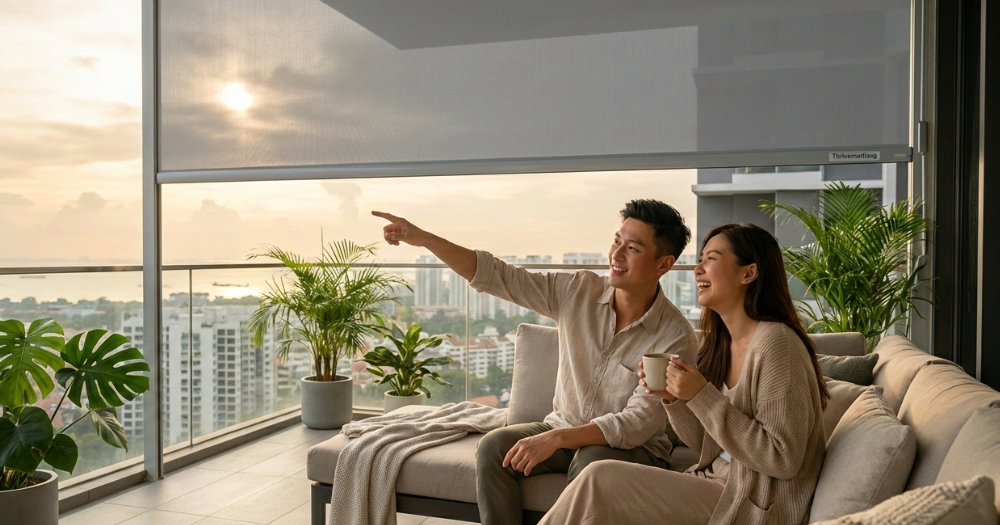
Many homeowners in Singapore misunderstand the fundamental engineering differences between Zipscreen™ vs Ziptrak for high-rise balconies. In the high-stakes environment of a 30th-story condo, a “cheap” outdoor blind isn’t just a bad aesthetic choice—it’s a safety hazard. Standard outdoor rollers often flap violently during a Sumatra Squall, leading to frayed edges, motor burnout, and the dreaded “blow-out” where the fabric escapes its tracks.
This article serves as a focused guide explaining Zipscreen™ vs Ziptrak for high-rise balconies to help you navigate the sea of marketing jargon and technical specs.
ADVERTISMENT
Why Finding the Right Furnishing is So Difficult for Singaporeans
In Singapore’s saturated renovation market, finding reliable balcony solutions is surprisingly difficult.
- The “White Label” Scam: Many vendors claim to sell “Original Zip Blinds” but actually install unbranded, China-made systems with inferior powder coating that chips within months.
- The Utility Gap: Homeowners often expect 100% waterproofing, but without the patented side-retention of Zipscreen™ or Ziptrak, rain “mists” through the gaps.
- Cost of Purchasing: A genuine Zipscreen™ system typically costs between S$25 to S$45 per square foot. When a vendor offers half that price, they are likely compromising on the motor (using noisy AC motors instead of silent, high-torque DC ones) or the fabric tensile strength.
According to consumer advice from CaseTrust and portals like Qanvast and Renopedia, the #1 complaint regarding balcony blinds involves poor after-sales service when these “budget” systems inevitably fail.
Technical Deep Dive: Zipscreen™ vs Ziptrak
The Retention Mechanism: z-LOCK™ vs. Kedar Tape
The core difference lies in how the fabric stays in the track:
- Zipscreen™: Uses patented z-LOCK™ technology. The zip is hidden within the side channel, providing a sleeker, more “built-in” look. This creates a complete seal that prevents insects and light rain from entering.
- Ziptrak: Uses Kedar tape (Cordura). While highly durable and originally from Australia, the Kedar tape is often visible on the fabric skin, which some homeowners find less aesthetically “clean” compared to Zipscreen™.
Wind Resistance Benchmarks
In Singapore, wind speeds on high floors can be 40% higher than at ground level due to the Venturi Effect.
- Zipscreen™: Tested to withstand wind speeds of up to 130km/h (though it is recommended to retract any blind above 50km/h for longevity).
- Ziptrak: Rated for similar high-wind loads, but its manual spring-balanced system is often preferred for those who want to “feel” the tension.
Feature | Zipscreen™ | Ziptrak |
Max Width | Up to 7.0m (Extreme) | Up to 6.0m (PanoView) |
Aesthetics | Ultra-slim, hidden zips | Robust, visible Kedar |
Operation | Primarily Motorised | Spring-balanced Manual/Motor |
Wind Rating | Very High (130km/h+) | Very High (Up to 130km/h) |
Innovation & Design Centre
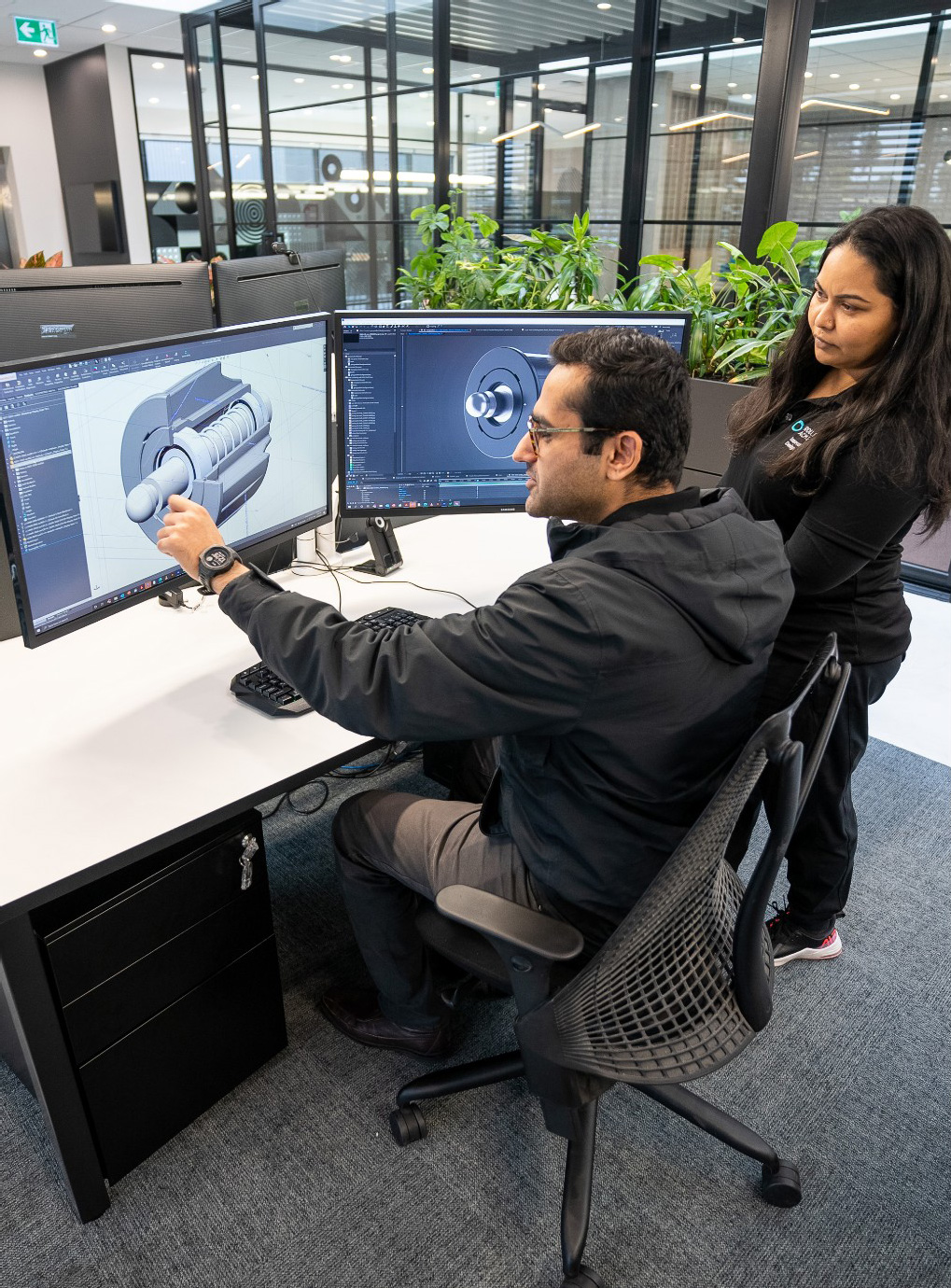
Based in Melbourne, Australia, our Innovation & Design Centre (IDC) is home to state-of-the-art testing machinery and over 25 dedicated engineers, designers and technicians – all focused on continuously delivering market-leading solutions.
With almost four decades of R&D, every Zipscreen component is quality assured, rigorously cycle tested 10,000 times and backed by our five-year warranty.
Case Study: Temperature Control in Punggol High-Rise

In a 2025 study of a 4-bedroom condo at Waterbay (Punggol), we compared a unit with Zipscreen™ (1% openness) against a neighbor with no balcony protection.
- Cause: The Zipscreen™ acted as a thermal barrier, reflecting 90% of UV rays.
- Effect: The internal temperature of the living room dropped by 4.2°C.
- Outcome: The homeowner saved 30% on monthly air-conditioning bills and converted their balcony into a functional home office.
For those considering other options, read our guide on Zipscreen™ vs outdoor roller blinds or Zipscreen™ vs invisible grilles.
ADVERTISMENT
Mistakes and Traps Home Owners in Singapore Faced
The “100% Waterproof” Trap: No mesh blind is truly 100% waterproof. They are water-resistant. During a heavy storm, “misting” can occur. If a vendor promises a bone-dry balcony with mesh, they are likely misleading you. For total enclosure, see our guide on balcony glass enclosures.
- Mistake #1: Ignoring MCST Guidelines. Many condos have strict rules on the color and transparency of blinds. Installing the wrong “shade” of grey can lead to a legal notice from your management.
- Mistake #2: Underestimating Maintenance. Dirt in the tracks is the #1 cause of jammed zips. See which blind system requires less maintenance to save on future repair costs.
- Mistake #3: Picking the Wrong Fabric Openness. For high-rise wind protection, a 1% to 3% openness is the sweet spot. Anything higher (like 5% or 10%) allows too much rain to spray through.
Making the Choice: The TCO Framework
When choosing between Zipscreen™ and Ziptrak, use the Total Cost of Ownership (TCO) model:
TCO = {Initial Price} + {Maintenance} times {Years}) + {Replacement Cost}
While Zipscreen™ may have a higher upfront cost, its 10-year lifespan and wind resistance make it cheaper over a 7-year period than replacing cheap manual blinds twice.
For more insights on durability, read which balcony blind lasts the longest or check our noise reduction comparison.
Common Balcony Questions
Expert insights for Singaporean High-Rise Living
What is the main difference between Zipscreen and Ziptrak? +
The primary difference is the retention technology. Zipscreen™ uses the z-LOCK™ system for a hidden, sleek finish, whereas Ziptrak uses Kedar tape, which is often visible on the fabric edge. Both are excellent for high-rise wind protection, but Zipscreen is generally considered more architecturally minimalist.
Are Zipscreen blinds allowed in HDB flats and Condos? +
Yes, but they must comply with URA and MCST guidelines. Most condos require specific colors (like Bronze or Charcoal) and a certain level of transparency (e.g., 1% openness) to maintain the building's facade. Always check with your Management Office before proceeding with installation.
Can Zipscreen blinds really block 100% of rain? +
No mesh blind is 100% waterproof. Zipscreen™ with a 1% openness fabric can block roughly 95-99% of rainwater. During extreme Singapore monsoons, you may experience a slight "mist" effect due to wind-blown droplets passing through the microscopic gaps in the weave.
How much does a Zipscreen installation cost in Singapore? +
For a standard 3-meter balcony, prices generally range from S$1,800 to S$2,800. The cost varies based on the size, the type of motor (e.g., Somfy vs. Automate), and the fabric's UV rating. Investing in genuine hardware ensures longevity against Singapore's humidity.
Why do high-rise balconies need zip systems specifically? +
High-rise units experience the Venturi Effect, where wind accelerates between buildings. Standard roller blinds will flap and can be ripped out of their brackets. A zip-retention system locks the fabric into the side tracks, ensuring the blind remains stable and safe even in gusty conditions.
Zipscreen™ vs Ziptrak
High-Rise Guide
What it is: A technical comparison of the two leading track-guided outdoor blind systems in Singapore, designed specifically for high-rise balconies.
Why it matters: High-floor units face extreme wind loads and rain; choosing the wrong system leads to mechanical failure and safety risks.
Who it’s for: Singaporean homeowners (Condo/HDB) seeking to weather-proof their balconies.
To evaluate any zip blind system, homeowners should use the Triple-S Framework:
- Seal (z-LOCK): Ensure the system provides a gapless connection to the track to block insects and rain.
- Stability (Side-Retention): The system must handle wind loads up to 50km/h without the fabric “popping out.”
- Smart-Control (Automation): High-rise units benefit from obstacle detection motors that stop the blind if it hits a chair or object.
In high-rise settings, manual blinds are often left down during storms because they are “too much work” to raise. This leads to wind damage. A motorized system with a wind sensor is a safety feature, not just a convenience, as it automatically protects your investment when you aren’t home.
- Zipscreen™ offers a cleaner aesthetic for modern condos.
- Ziptrak offers a robust manual spring-feel for those who prefer physical operation.
Cost Factor: Genuine systems cost S$25-S$45 psf; anything less is a “White Label” risk.
Zipscreen™ Technical Compliance Benchmarks
| Feature | Zipscreen™ Specification | MCST/URA Compliance |
|---|---|---|
| Fabric Porosity | 1% to 10% Openness | ✓ Approved (Natural Ventilation) |
| Mechanism Type | Fully Retractable Motorized | ✓ Approved (BMSMA Section 37) |
| Wind Resistance | Up to 130km/h (Static Load) | ✓ High-Rise Certified |
| Pelmet Size | Ultra-Slim 120mm / 150mm | ✓ Fits Facade Standard Design |
| Locking Tech | Patented z-LOCK™ Side Channels | ✓ Pest & Gap Protection |
*Data based on 2026 Singapore BCA testing standards for outdoor screening systems.
ADVERTISMENT
Read more about Zipscreen™

Zipscreen™ vs Ziptrak: The Ultimate Guide for Singapore High-Rise Balconies (2026 Comparison)
January 24, 2026 No Comments
Read More » 
Zipscreen™ vs Outdoor Roller Blinds: The Ultimate 2026 Singapore Balcony Guide
January 24, 2026 No Comments
Read More » 
Zipscreen™ vs Invisible Grilles: The Ultimate Singapore Balcony Guide for Safety & Comfort
January 24, 2026 No Comments
Read More » 
Zipscreen™ vs Balcony Glass Enclosures: The Ultimate 2026 Singapore Comparison Guide
January 24, 2026 No Comments
Read More » 
Best Balcony Blind for Wind Resistance in Singapore: Zipscreen vs Ziptrak vs Outdoor Blinds
January 24, 2026 No Comments
Read More » Woud like to know more?
Leave behind your contact details, Our sales-representatives will connect with you via whatsApp
Show Room Opening Hours:
Mon – Sat: 9:00AM – 6:00PM
Zipscreen

Zipscreen™ vs Ziptrak: The Ultimate Guide for Singapore High-Rise Balconies (2026 Comparison)
Read More » January 24, 2026 No Comments